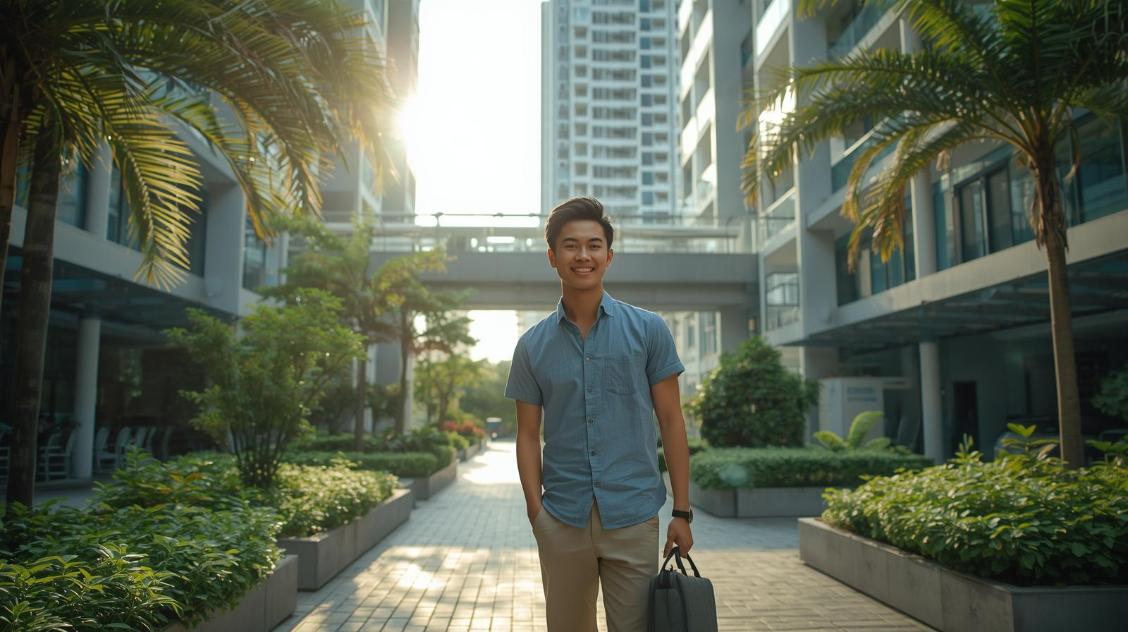
Singapore’s use of transformational strategies in urban development has established a benchmark for innovative thinking in property development. Singapore achieves a perfect balance between daily upliftment and improving the commercial viability of adaptive properties.
Having integrated real estate resources enables buyers, investors, and commercial entities to understand how modern residential systems and environments merge adaptive living with integrated mobility and economic ecosystems.
Smart Planning Meets Livable Design
Innovative real estate solutions in Singapore are based on the theory of ‘master planning,” a balance of systems, density, and comfort. Developments have become more than simple housing structures, clusters, or units.
Innovations have given rise to engineered systems and structures with integrated green corridors, pedestrian systems, lifestyle and amenity retail, and multi-modal transport-configured ecosystems.
These configurations focus on reduced/alternative commuting stress while enhancing outdoor activity and social and community interaction. In a built/urban environment, systems that sustain economic growth and community health and activity also preserve the environment.
Modern residential systems that integrate energy-efficient technologies and use sustainable materials, along with natural ventilation strategies, reduce expenses for residents and enhance their quality of life.
These systems align responsible and value-enhancing development with the strengthening of a built environment.
Connectivity That Powers Economic Activity
Transit integration is one of Singapore’s real estate and economical business successes. Professionals are able to make seamless transitions from business to residential districts.
Homes that are close to residential highways and major commercial areas are able to reduce travel times, which improves productivity and company work-life balance. This is one of the many factors that influences which location to choose for company operational bases.
Residential real estate projects create microeconomies. Small and medium enterprises benefit economically from the establishment of retail and services around residential real estate projects.
This approach is economically beneficial to the residents because it improves the accessibility of services and goods. Closed economies are economically active real estate microzones rather than providing purely active zones for living.
ALSO READ: Revolutionizing Business: The Global Impact of Cryptocurrency Trading Platforms
Business Innovation Being Encouraged by Lifestyle Amenities
Integrated co-working lounges, meeting pods, fitness areas, and landscaped social areas are the latest trends in property innovation. These amenities enable remote work and shift the balance of business activity toward flexible models.
It is a wonderful incentive for professionals to work, collaborate, and host meetings within their residential spaces.
The proximity of excellent schooling, healthcare, and recreation also helps families. When services are essential and nearby, families are more settled and save time. This time savings leads to more dependable work and improves the entire business ecosystem.
Long-Term Value Creation
Buyers of Singapore real estate developments feel confident for several reasons. They are confident in the sustained regulations, order, and governance of construction.
Singapore also sets the standard for process transparency and building quality, making it easy for investors to predict demand because of the living conditions. A well-designed neighborhood will last and preserve the value of the rentals.
With the advancement of technology and the increasing value placed on sustainability and community cohesion, the quality of living and working will continue to improve.
Singapore proves that real estate encompasses more than buildings. It is a space where the quality of life meets economic prosperity, resulting in thriving communities and powerful business hubs.